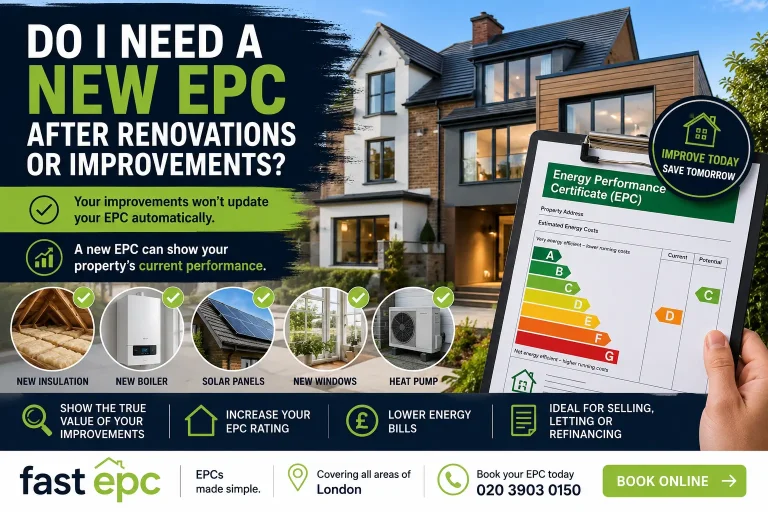

Renovating your property does not automatically mean that you need to replace a valid EPC. However, your existing certificate will not automatically update when you install a new boiler, insulation, double glazing, solar panels or other energy-efficiency improvements. A new EPC assessment can show the property’s current energy performance and may be particularly important before selling or letting, after major alterations, or where a landlord needs to demonstrate an improved rating.
You have installed a new boiler, upgraded the windows or spent thousands of pounds insulating your property.
But your Energy Performance Certificate still shows the old rating.
So, do you need a new EPC after renovations?
The answer depends on what work you have carried out and what you intend to do with the property.
An existing EPC is generally valid for ten years. Renovating the property does not necessarily cancel that certificate.
However, an EPC is based on the property as it was assessed at the time. Improvements made afterwards do not simply appear on the existing certificate.
That creates an important distinction:
You may not be legally required to obtain another EPC simply because you renovated, but commissioning a new assessment may be necessary or worthwhile if you want the property’s current energy performance to be reflected.
This is particularly relevant for:
- landlords improving an F or G-rated property;
- homeowners preparing to sell;
- property developers completing a refurbishment;
- owners installing solar panels or heat pumps;
- landlords upgrading insulation or heating;
- commercial property owners carrying out major refurbishment;
- properties undergoing extensions or conversions.
If you have recently improved a property in London and want to know its current EPC rating, Fast EPC can carry out a new assessment and explain how the completed improvements are reflected in the assessment.
Does an EPC automatically update after renovations?
No.
An EPC does not automatically update when improvements are made to a property.
If your certificate was produced before you installed a new boiler, for example, the existing certificate continues to describe the property based on the information recorded when that assessment was completed.
The same principle can apply after installing:
- double glazing;
- loft insulation;
- cavity-wall insulation;
- internal or external wall insulation;
- solar panels;
- a heat pump;
- improved heating controls;
- a new hot-water system;
- low-energy lighting;
- other qualifying energy-efficiency measures.
There is no automatic connection between your building work and the lodged EPC that causes the old certificate to recalculate itself.
If you want an EPC showing the property in its improved condition, a new assessment will normally be needed.
Do renovations invalidate an existing EPC?
Not necessarily.
A domestic EPC is generally valid for ten years and can be reused during that period.
Therefore, installing a new boiler or replacing windows does not automatically make the existing certificate legally invalid.
However, there is a difference between a certificate being valid and it being an accurate representation of the property after substantial improvements.
Imagine that a house received an EPC rating of D in 2023.
The owner subsequently installs:
- additional loft insulation;
- new double glazing;
- a modern heating system;
- solar PV panels.
The 2023 certificate may still be within its ten-year validity period.
But it obviously cannot have assessed improvements that did not exist when the assessor visited.
A new EPC would reassess the property in its current condition.
When do I legally need a new EPC?
For most homes in England and Wales, an EPC is required when a qualifying property is:
- built;
- sold;
- marketed for sale;
- rented out;
- marketed to prospective tenants.
If a valid EPC already exists, it can generally be reused during its validity period.
That means homeowners should not assume that every renovation creates an immediate legal requirement to order another certificate.
There are, however, circumstances involving alterations and modifications where EPC requirements can become more complicated.
Major changes to a building’s layout, use, separate occupation or fixed building services can create different requirements, particularly for commercial properties.
If significant structural or use changes have been made, it is sensible to establish the EPC position rather than relying on the certificate issued for the previous configuration.
Should I get a new EPC after improving my property?
There are several situations where commissioning another EPC can make practical sense even if your existing certificate has not expired.
You are selling the property
Buyers may be interested in improvements that reduce energy use or increase the property’s EPC rating.
If your old EPC says D but substantial improvements could move the property into C, continuing to market the property using the old rating may fail to show its current energy performance.
A new EPC can provide an updated assessment.
You are a landlord
The EPC rating has regulatory importance for privately rented property.
If improvements were carried out specifically because a property had an F or G rating, simply completing the work does not make the old F or G certificate display a higher rating.
A reassessment may therefore be important in demonstrating the property’s performance following the improvements.
You have completed a major refurbishment
Where the building is substantially different from when it was last assessed, a fresh EPC can provide a clearer picture of its current performance.
You installed several energy-efficiency measures
One improvement may produce only a modest difference.
Several measures together can have a more significant effect.
A homeowner who installs insulation, improves heating controls, replaces an inefficient heating system and adds solar panels may therefore have a stronger reason to commission another assessment.
Do I need a new EPC after installing a new boiler?
Not automatically.
Replacing a boiler does not normally mean that an otherwise valid EPC immediately becomes invalid.
However, heating is an important part of an EPC assessment.
A new heating system may affect the property’s calculated energy performance, depending on factors including:
- the previous heating system;
- the new system;
- heating controls;
- hot-water arrangements;
- property construction;
- insulation;
- secondary heating.
If the old EPC was produced with an inefficient heating system and you have since replaced it, a new assessment may produce a different result.
Do not assume that installing an expensive new boiler guarantees a particular EPC rating.
The assessor considers the property as a whole.
Do I need a new EPC after installing double glazing?
Usually not simply because the windows have been replaced.
However, glazing is one of the features considered during an EPC assessment.
Replacing older single glazing with suitable modern glazing may improve the property’s modelled energy performance.
The effect will depend on factors such as:
- how much of the property is glazed;
- the previous windows;
- the replacement glazing;
- the age and construction of the property;
- other energy-efficiency measures.
If you intend to obtain a new EPC, keep documentation showing what was installed and when.
This can be particularly useful where details are not obvious during a visual inspection.
Do I need a new EPC after loft insulation?
Again, not automatically.
But loft and roof insulation can make an important difference to energy performance.
The crucial issue is evidence.
An assessor may not always be able to see the full depth or specification of insulation once building work has been completed.
For example, insulation may be:
- concealed behind plasterboard;
- underneath flooring;
- within a converted roof;
- covered during refurbishment.
Keep photographs, invoices and installation documentation rather than assuming the assessor will be able to verify concealed work later.
What if the EPC assessor cannot see my new insulation?
This is an issue property owners frequently overlook.
An EPC assessment must be based on the applicable methodology and evidence available to the assessor.
Simply telling the assessor that insulation was installed may not always be enough to record a particular specification.
That is why documentation should be retained during renovation.
Useful evidence can include:
- installer invoices;
- product specifications;
- dated photographs taken during installation;
- Building Regulations documentation;
- guarantees;
- certificates;
- architectural or construction information.
Ideally, think about EPC evidence before the insulation disappears behind finished walls, ceilings or floors.
Do I need a new EPC after wall insulation?
Installing cavity, internal or external wall insulation does not automatically mean every property requires a replacement EPC.
But wall construction and insulation can significantly affect energy calculations.
Evidence becomes particularly important when the insulation is concealed.
Owners of older or historic buildings should also be cautious.
Internal and external wall insulation can affect moisture movement, appearance and building fabric. Planning, conservation or technical advice may be needed before carrying out work on certain properties.
An EPC recommendation is not permission to alter a building.
Do I need a new EPC after solar panels?
Installing solar photovoltaic panels does not automatically invalidate your existing EPC.
However, solar PV can affect the calculated energy performance of a property.
If your EPC predates the installation, the old certificate obviously cannot show the panels as part of the assessment carried out at that time.
A new EPC can assess the property with the installation in place.
Keep relevant information about the solar system, including installation documentation.
This can be especially useful where the new EPC is being commissioned to demonstrate improvements before selling or letting.
Do solar panels automatically increase an EPC rating?
Not necessarily by a specific amount.
Solar PV can contribute positively to the calculation, but EPC ratings are based on the complete property.
Two otherwise different homes with the same number of solar panels can receive different ratings.
Factors such as construction, insulation, heating, glazing and hot-water systems still matter.
Property owners should therefore be cautious about claims such as:
“Solar panels will automatically move your property from D to C.”
The only reliable way to establish the resulting EPC rating is through the appropriate assessment.
Do I need a new EPC after installing a heat pump?
Not automatically simply because a heat pump has been installed.
But changing the primary heating system can materially change the information used in an EPC assessment.
A new assessment may therefore be worth considering after installation, particularly where improving the EPC rating was one of the reasons for the project.
The outcome depends on the complete property.
The assessor may consider factors including:
- heat-pump type;
- heating controls;
- hot-water arrangements;
- property insulation;
- heat loss;
- other heating systems;
- building construction.
Installing a heat pump should not be treated as a guarantee of reaching EPC C or any other particular band.
Do I need a new EPC after an extension?
An extension requires more careful consideration than a simple replacement boiler or window upgrade.
Extending a property can change:
- total floor area;
- external wall area;
- roof area;
- glazing;
- heating;
- insulation;
- building layout.
Building Regulations requirements may also apply independently of EPC rules.
The existing EPC does not automatically recalculate itself to include the extension.
If you are selling or letting after substantial alterations, it can therefore be sensible to establish whether a new assessment is appropriate or required in the circumstances.
Do I need a new EPC after a loft conversion?
A loft conversion can substantially change the characteristics of a dwelling.
It may introduce:
- additional heated floor area;
- roof insulation;
- new windows or rooflights;
- additional heating;
- new walls and ceilings;
- altered ventilation.
The EPC produced before the conversion will not automatically update to include those changes.
Where the property is being sold or let following the conversion, owners should check that their EPC position reflects the property being marketed.
What about a garage conversion?
The same principle applies.
Turning an unheated garage into habitable accommodation can change the building’s heated area and thermal characteristics.
The conversion may involve:
- new insulation;
- heating;
- windows;
- doors;
- floor upgrades;
- wall alterations.
If your previous EPC assessed the property while that space was an unheated garage, it will not automatically update after conversion.
Do I need a new EPC after a full refurbishment?
A full refurbishment is one of the strongest reasons to consider commissioning an updated EPC.
A substantial renovation may include:
- new heating;
- insulation;
- windows;
- doors;
- lighting;
- hot-water systems;
- solar panels;
- extensions;
- conversions.
The finished property may perform very differently from the building assessed several years earlier.
Developers should also consider EPC requirements early in the project rather than leaving the issue until the property is ready to be marketed.
Should I get the EPC before or after renovations?
If the purpose of the assessment is to demonstrate the benefit of completed improvements, the new EPC would normally be most useful after the relevant work has been completed.
Otherwise, the assessor cannot assess improvements that do not yet exist.
There can still be value in looking at an existing EPC before work begins.
Its recommendations may help identify areas where improvements could potentially be made.
However, EPC recommendations should be considered alongside appropriate professional advice, Building Regulations, planning requirements and the actual condition of the building.
Can I get an EPC during renovation?
Potentially, but timing matters.
If important elements of the building are incomplete, the assessment may not represent the final property you intend to sell or let.
For example, commissioning an EPC before:
- the new heating system is operational;
- insulation is completed;
- solar panels are installed;
- replacement windows are fitted
could mean those future improvements are not reflected in that assessment.
If your objective is an EPC showing the finished refurbishment, arrange the assessment at the appropriate stage.
I improved an F or G rental property. Do I need another EPC?
This is particularly important for landlords.
Current domestic Minimum Energy Efficiency Standards in England and Wales generally prevent relevant privately rented properties from being let or continuing to be let with an EPC rating below E unless a valid exemption applies.
If a property has an F or G rating, the landlord may need to carry out relevant improvements or register an applicable exemption.
Where improvements have been carried out to address a poor rating, landlords need to consider how compliance will be demonstrated.
Do not simply assume:
“I completed the recommended work, so the property must now be E.”
The final rating depends on the assessment.
If the property remains below the applicable minimum after relevant improvements, separate MEES exemption provisions may need to be considered.
What if improvements don’t bring the property up to EPC E?
The current domestic MEES regime contains specific provisions for properties that cannot be improved sufficiently within the applicable rules.
Government guidance currently sets out a £3,500 including VAT cost cap for relevant domestic energy-efficiency improvements.
Where all relevant improvements have been made within the applicable requirements and the property remains below E, an exemption may be available.
Other exemptions can apply in particular circumstances, including issues involving:
- high costs;
- wall insulation;
- third-party consent;
- property devaluation.
Exemptions have evidence requirements and must be registered where required.
Many registered exemptions last five years.
Landlords should therefore distinguish between:
improving the property,
obtaining an EPC, and
registering a MEES exemption.
They are related, but they are not the same thing.
Do I need a new commercial EPC after refurbishment?
Not every commercial refurbishment automatically triggers a new EPC.
This is an important distinction that commercial landlords and property managers should understand.
For non-domestic buildings, an internal refit involving new heating, hot water, air conditioning or mechanical ventilation does not, by itself, necessarily trigger a new EPC.
However, the rules become different where a building is modified so that it contains more or fewer parts designed for separate use and the modification also involves providing or extending fixed services such as:
- heating;
- hot water;
- air conditioning;
- mechanical ventilation.
In those circumstances, an EPC must be provided to the owner on completion of the work by the person carrying it out.
Commercial alterations can therefore require a more detailed assessment of the circumstances than simply asking whether “refurbishment” has taken place.
Examples of commercial EPC changes
Consider an office building that undergoes a cosmetic refurbishment.
The owner replaces carpets, decorates the walls and installs a new reception desk.
That does not mean a new EPC is automatically required because of those changes alone.
Now consider a commercial building that is reconfigured into several independently occupied units and the works include extending fixed heating or ventilation services.
That can have different EPC consequences.
Similarly, converting or subdividing:
- offices;
- retail units;
- industrial premises;
- mixed-use buildings;
- warehouses
can affect which parts require assessment.
Commercial owners planning major reconfiguration should therefore establish the EPC requirements before marketing the resulting units.
What if my commercial EPC is F or G?
Commercial landlords must also consider non-domestic MEES.
The current regime generally requires relevant privately rented non-domestic property to meet at least EPC E unless an exemption applies.
If refurbishment work has been undertaken specifically to improve a poorly rated commercial property, commissioning an updated assessment may be important in establishing the resulting rating.
Commercial MEES has separate rules and exemptions from the domestic regime, so landlords should not assume the domestic £3,500 cost-cap rules apply to commercial buildings.
What evidence should I keep after renovations?
This is one of the most important practical steps during any energy-efficiency project.
Keep evidence as the work progresses.
Depending on the improvement, useful documents may include:
- invoices;
- receipts;
- product specifications;
- installation certificates;
- guarantees;
- Building Regulations documents;
- photographs before work;
- photographs during installation;
- photographs after completion;
- window specifications;
- insulation specifications;
- boiler documentation;
- heating-control information;
- solar PV documentation;
- heat-pump information;
- architectural drawings;
- completion certificates.
Do not throw away paperwork simply because the work is finished.
Some energy-efficiency features become impossible or difficult to inspect once the property has been decorated.
Can renovations make my EPC rating worse?
Potentially.
Spending money on a property does not automatically mean its EPC rating will increase.
A refurbishment can change several characteristics simultaneously.
For example, adding a large extension increases usable floor area but can also increase external walls, glazing and heating demand.
Changing the heating system can also affect the calculation differently from what the owner expected.
EPC methodology assesses the building’s energy performance rather than how expensive or attractive the renovation was.
A £50,000 kitchen has little relevance to an EPC simply because it cost £50,000.
Energy-related characteristics matter.
How much can renovations improve an EPC rating?
There is no universal answer.
The improvement depends on:
- the starting rating;
- property age;
- construction;
- insulation;
- heating;
- glazing;
- hot water;
- lighting;
- renewable technology;
- the combination of improvements.
A property near the top of band D may require relatively little movement to reach C.
Another property at the bottom of D could require substantially more.
That is why owners should be cautious about anyone guaranteeing a particular EPC rating before the relevant assessment and information have been considered.
Does a new EPC replace the old EPC?
A newly lodged EPC becomes the latest assessment available for the property.
This is another reason to consider timing carefully.
If substantial improvements are still underway, commissioning repeated EPC assessments may be unnecessary.
Where possible, coordinate the final assessment with completion of the relevant energy improvements.
Do I need a new EPC before selling after renovations?
If you already have a valid EPC, renovation alone does not necessarily mean you must commission another one before selling.
However, there is a commercial reason to consider it.
If the old EPC substantially understates the energy performance of the renovated property, buyers will see an energy rating based on its previous condition.
For a property where significant improvements have been made, an updated EPC can provide prospective buyers with current information.
If there is no valid EPC, one generally needs to be commissioned before the property is marketed for sale.
Do I need a new EPC before renting after renovations?
A landlord should first establish whether a valid EPC already exists and whether the property falls within the applicable EPC and MEES requirements.
Where the property has been improved from a poor rating, an updated assessment can be particularly important.
Remember that the current domestic MEES requirement for relevant privately rented homes is generally EPC E or above unless a valid exemption applies.
Landlords should not advertise or let a property on the assumption that improvements have achieved the necessary rating without establishing their compliance position.
Is an EPC still valid after a new boiler?
Generally, yes. Installing a new boiler does not automatically cancel an otherwise valid EPC. However, the old certificate will not automatically show the new heating system.
Is an EPC still valid after double glazing?
Generally, yes. Replacing windows does not automatically invalidate the existing certificate, but a new assessment may reflect the upgraded glazing.
Does an EPC update automatically after insulation?
No. Your lodged EPC does not automatically change because insulation has subsequently been installed.
Does an EPC update automatically after solar panels?
No. A new assessment is needed if you want the property’s EPC to assess the solar installation as part of its current characteristics.
Does an EPC update automatically after a heat pump?
No. Changing the heating system does not automatically recalculate an existing certificate.
Does an extension invalidate an EPC?
Not automatically in every case. However, significant alterations can change the characteristics of the property and may interact with EPC and Building Regulations requirements. The individual circumstances should be checked.
How long does an EPC last after renovations?
An EPC is generally valid for ten years from the date it was issued. Renovation does not simply restart that ten-year period.
If you commission a new EPC following the work, the new certificate will have its own issue date.
Can I use my old EPC to sell my renovated house?
If the EPC remains valid and the circumstances do not otherwise require a new certificate, it may generally be reused.
However, it may not show improvements completed after the original assessment.
Should property developers get a new EPC after refurbishment?
Developers should establish the EPC requirements for the particular project, especially where properties have been extended, converted, subdivided, newly constructed or substantially altered.
Where an EPC is required for marketing, it should reflect the building being offered for sale or rent in accordance with the applicable rules.
Can Fast EPC tell me how much my rating will improve before the assessment?
An assessor can explain the factors that influence an EPC and assess the completed property using the applicable methodology.
However, property owners should be cautious about expecting a guaranteed final rating simply because particular improvements have been installed.
The complete building matters.
Book a New EPC After Renovations in London
If you have recently renovated or upgraded your property, your existing EPC may no longer show its current energy performance.
Fast EPC provides professional EPC assessments across London for:
- homeowners;
- landlords;
- property developers;
- estate agents;
- letting agents;
- property managers;
- commercial property owners.
We assess houses, flats and qualifying commercial properties throughout London.
If you have installed a new boiler, insulation, double glazing, solar panels, a heat pump or completed a wider refurbishment, have your relevant paperwork available for the assessor.
Book your EPC assessment online or call Fast EPC to discuss your property.
If you are carrying out an extension, conversion, subdivision or major commercial refurbishment, establish whether additional Building Regulations, planning or EPC requirements apply to the work.
This article provides general information for properties in England and Wales and should not be treated as legal, planning or Building Regulations advice. Requirements can depend on the building and the work carried out.