
Commercial landlords have spent years hearing that every rented business property would need to reach EPC C by 2027 and EPC B by 2030.
That is no longer the Government’s proposed approach.
In June 2026, the Government changed direction.
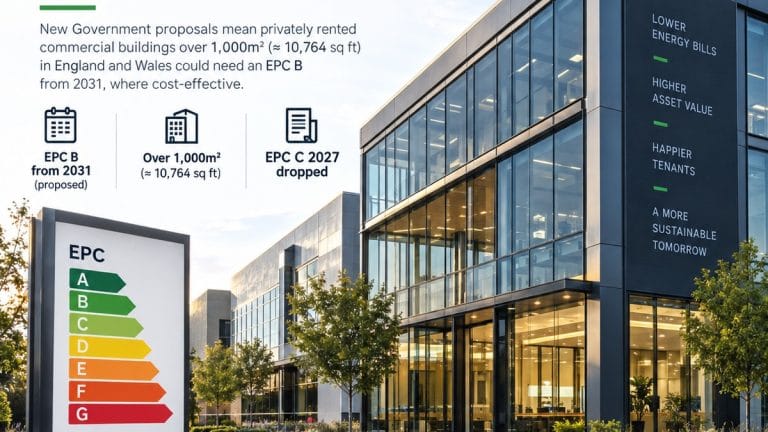
The current proposal is that privately rented non-domestic buildings over 1,000 square metres in England and Wales would need to achieve EPC B from 2031, where reaching that standard is cost-effective.
The proposed EPC C milestone for 2027 has been dropped.
Buildings below 1,000m² are intended to remain subject to the existing minimum EPC E standard, with no new deadline currently announced for moving them beyond E.
EPC B by 2031 is Government policy direction, but it is not yet the minimum standard in force today.
Secondary legislation still needs to pass before the higher requirement becomes legally binding.
For landlords with offices, warehouses, industrial units, large retail premises and other sizeable commercial buildings, however, 2031 is close enough that major refurbishment and investment decisions should already take the proposed standard into account.
What is the commercial EPC minimum rating today?
The current minimum EPC rating for most privately rented non-domestic property in England and Wales is EPC E.
Since 1 April 2023, qualifying rented commercial properties generally cannot continue to be let with an EPC rating of F or G unless an applicable exemption has been registered.
This applies even where the tenant was already occupying the building before April 2023.
The existing rule therefore remains extremely important.
A landlord should not read about the proposed 2031 EPC B standard and assume nothing needs to happen until 2031.
If a qualifying commercial property is currently rated F or G, the problem already exists.
What are the proposed commercial EPC rules for 2031?
The Government announced on 18 June 2026 that it intends to introduce a more targeted version of the previously proposed commercial MEES reforms.
| Commercial property | Current minimum | Proposed future position |
|---|---|---|
| Privately rented non-domestic building over 1,000m² | EPC E | EPC B from 2031 where cost-effective |
| Privately rented non-domestic building below 1,000m² | EPC E | EPC E continues under current proposal |
| Qualifying F or G commercial property | Generally cannot be lawfully let without exemption | Already requires action now |
| Proposed EPC C requirement for 2027 | Not in force | Dropped |
Is EPC B by 2031 already law?
No. The proposed EPC B standard for larger commercial buildings is not yet in force.
The Government has confirmed its intention to introduce the standard, but secondary legislation is still required.
A commercial landlord should therefore avoid two opposite mistakes: assuming EPC B is already legally mandatory, or assuming the announcement can simply be ignored because legislation has not yet passed.
Commercial property improvements can involve lengthy planning, tenant negotiations, capital expenditure approvals, design work, procurement and installation.
Has EPC C by 2027 been cancelled?
Yes. The previously proposed interim EPC C milestone for 2027 is not being taken forward.
Older guidance frequently describes a two-stage commercial MEES trajectory of EPC C by 2027 followed by EPC B by 2030.
That timetable should no longer be treated as the current Government proposal.
Which commercial buildings could need EPC B in 2031?
The proposed requirement targets privately rented non-domestic buildings over 1,000m² in England and Wales.
That is roughly 10,764 square feet, which may be easier to visualise for landlords, agents and investors who usually work in square footage.
That could include large offices, warehouses, logistics properties, industrial buildings, retail stores, supermarkets, leisure premises and other sizeable commercial assets.
The exact application will ultimately depend on the legislation and accompanying guidance.
If your building is close to 1,000m², establish exactly what floor-area measurement is recorded in your property information and wait for the final regulatory definition before making a legal conclusion purely from that number.
What happens if my commercial property is under 1,000m²?
Under the Government’s current proposal, privately rented non-domestic buildings below 1,000m² would continue to be subject to the existing minimum EPC E standard.
There is currently no new date announced requiring these smaller commercial properties to reach EPC B.
But an F- or G-rated qualifying property cannot simply wait until 2031.
What if my commercial property is exactly 1,000m²?
The current Government wording refers to buildings over 1,000 square metres.
The final legislation and detailed guidance will be what matters legally.
For properties sitting directly on or very close to the threshold, landlords should avoid relying on assumptions until the measurement rules are finalised.
Does EPC B 2031 apply to owner-occupied commercial buildings?
The announced policy concerns the non-domestic private rented sector.
That means the proposed MEES requirement is principally about rented commercial property.
An owner-occupied building can still be subject to other EPC requirements, building regulations or energy obligations, but that is not the same thing as the private rented sector MEES rule.
What if part of the building is rented and part is owner-occupied?
This can become more complicated.
Large commercial buildings are frequently divided into separate units or occupied under several arrangements.
The relevant EPC and MEES position can depend on how the building has been assessed, divided and let.
Does a mixed-use building need EPC B?
A mixed-use property can involve more than one EPC regime.
For example, a building may contain retail premises at ground level and residential flats above.
The commercial portion may require a non-domestic EPC while the residential accommodation may require domestic EPCs.
What happens if my commercial property is already EPC B?
If a qualifying commercial building already has a valid EPC B or A, it is considerably better positioned against the proposed 2031 standard.
However, landlords should still check the certificate’s expiry date, whether major alterations are planned, whether the EPC accurately reflects the present building and whether future changes could alter its assessment.
What if my commercial EPC is C?
A current EPC C rating complies comfortably with today’s minimum E standard.
But a building over 1,000m² rated C could potentially fall short of the proposed 2031 EPC B requirement.
The useful question is: what would move this particular building from C to B, and when would it be cheapest and least disruptive to carry out those works?
What if my commercial EPC is D or E?
A D- or E-rated building may comply today but could have a larger improvement gap if it eventually falls within the proposed EPC B regime.
For large buildings, these are the assets that deserve early modelling.
A landlord should establish the present rating, EPC recommendations, major plant age, lighting specification, heating and cooling systems, controls, insulation, glazing, renewable generation and planned maintenance cycles.
What if my commercial property is EPC F or G?
An F- or G-rated qualifying commercial property may already be non-compliant under today’s MEES rules.
This is more urgent than the proposed 2031 change.
The current minimum standard for qualifying privately rented non-domestic property is E.
What is the seven-year payback test?
The seven-year payback test is an important part of commercial MEES.
A landlord is not necessarily required to carry out every theoretically possible improvement regardless of cost.
Under the existing system, an improvement can fail the payback test where its purchase and installation cost is greater than the expected energy-bill savings produced over seven years.
The Government has stated that it intends to retain this cost-effectiveness mechanism as part of the proposed future regime.
What commercial MEES exemptions currently exist?
Commercial landlords can already encounter several exemptions depending on the circumstances.
These include situations involving the seven-year payback test, completion of all relevant improvements, certain wall-insulation risks, inability to obtain necessary third-party consent, qualifying property devaluation and some circumstances in which a person has only recently become the landlord.
Where an exemption is required, it normally needs to be properly evidenced and registered on the PRS Exemptions Register before it can be relied upon.
Does an exemption transfer when the property is sold?
Not necessarily.
Existing Government guidance states that registered exemptions do not automatically pass to a new owner when a property is sold or transferred.
A buyer acquiring an F- or G-rated tenanted property should therefore not assume that the seller’s exemption solves the issue indefinitely.
What are the penalties for commercial MEES breaches?
Current non-domestic MEES penalties can be significant.
Where a landlord lets a non-compliant property for less than three months, the financial penalty can be the greater of £5,000 or 10% of the property’s rateable value, subject to a maximum of £50,000.
For a breach lasting three months or more, the penalty can be the greater of £10,000 or 20% of the property’s rateable value, subject to a maximum of £150,000.
Details of non-compliance can also be published.
These are the enforcement limits under the current non-domestic MEES regime.
They should not automatically be assumed to be the final penalty structure for the proposed 2031 EPC B standard. The eventual enforcement framework, penalty caps and compliance procedures could be amended when secondary legislation is introduced.
Does an expired commercial EPC automatically mean the landlord is breaking MEES?
Not every expired EPC situation has an identical answer.
EPC requirements and MEES overlap, but they are not the same legal question.
For landlords approaching lease renewal, assignment, sale or refurbishment, the EPC status should be reviewed before documents are completed.
Does renewing a commercial lease trigger EPC problems?
Lease renewal is one of the most important moments to review commercial energy compliance.
Since April 2018, landlords have generally been prevented from granting a new qualifying tenancy or extending or renewing an existing tenancy where a covered property is below EPC E without an applicable registered exemption.
Since April 2023, the rules also extend to continuing to let qualifying sub-standard properties.
Should landlords put EPC clauses into new leases?
For large properties potentially affected by 2031, lease drafting deserves careful attention.
Energy improvements can require access, interfere with occupation and involve plant or controls operated by the tenant.
Landlords and tenants negotiating long leases should therefore consider future energy-performance obligations as part of the wider legal drafting.
Could tenant alterations reduce an EPC rating?
Potentially.
Changes to lighting, HVAC, heating controls and other systems can alter the energy model.
Will solar panels get a commercial property to EPC B?
Solar PV can improve the energy performance of some buildings.
But solar panels do not guarantee EPC B.
The effect depends on the individual building and its assessment.
What improvements can raise a commercial EPC rating?
Common areas worth investigating include lighting efficiency, lighting controls, heating and cooling plant, building-management controls, insulation, glazing, hot-water systems, renewable generation and the efficiency of fixed building services.
But EPC improvement should begin with assessment rather than shopping.
Should landlords upgrade to EPC B immediately?
Not necessarily.
A building already due for major refurbishment may make an early upgrade sensible.
For another building, immediate expenditure could mean replacing equipment years before the end of its useful life.
What should a landlord with a large property do now?
For a building potentially affected by the 2031 proposal, start with information rather than construction work.
Confirm the building’s current EPC and expiry date.
Check whether the property is clearly above, clearly below or close to 1,000m².
Review the existing rating and recommendations.
Check whether the asset is let on a tenancy covered by MEES.
Identify any registered exemptions and their expiry dates.
Review planned lease events between now and 2031.
Then model the likely path towards EPC B.
Worked example: 1,600m² office rated EPC D
Consider a privately rented 1,600m² office building in London.
The current EPC is D, the lease expires in 2029, the lighting is partly fluorescent and the heating and cooling system is approaching replacement age.
Under today’s rules, an EPC D rating is above the minimum E standard.
But the building appears to fall within the type of asset targeted by the proposed 2031 policy.
The landlord could assess whether the 2029 lease event provides an opportunity to combine lighting, controls and HVAC upgrades.
Worked example: 650m² high-street retail unit rated EPC E
Now consider a 650m² rented retail property with an EPC E.
Under the present Government proposal, the building is below the 1,000m² threshold for the proposed 2031 EPC B requirement.
It would therefore remain subject to the existing EPC E minimum unless policy changes again.
Worked example: 1,200m² warehouse rated EPC F
This case is more urgent.
The property is privately rented, over 1,000m² and currently rated F.
The landlord should not focus first on 2031. The immediate issue is today’s EPC E minimum.
Once current compliance has been resolved, the longer-term route towards B can be considered.
What should buyers check before purchasing a commercial property?
A buyer acquiring a rented commercial property should not treat the EPC as a document to glance at after agreeing the price.
Check the current rating and expiry, whether the building is over 1,000m², any registered exemptions, completed improvement works, lease access provisions and major plant replacement cycles.
Could EPC B affect commercial property value?
It could influence investor, lender and tenant decisions even before the proposed rule becomes law.
That does not mean every sub-B property becomes stranded. It means energy performance is increasingly becoming one component of normal commercial property due diligence.
Why waiting until 2030 could be expensive
Five years can look like a long time in property.
It is much shorter when a landlord must coordinate surveys, leases, tenant consent, capital approvals, planning, procurement and construction.
Portfolio owners face an additional challenge because improving many large buildings at the same time can create a major procurement and capital-planning problem.
Commercial EPC B 2031 FAQs
Does every commercial property need EPC B by 2031?
No. The current Government proposal targets privately rented non-domestic buildings over 1,000m² in England and Wales, where achieving B is cost-effective. Smaller buildings are currently intended to remain subject to EPC E.
Is EPC B mandatory now?
No. EPC E remains the current minimum under commercial MEES for qualifying rented property. The proposed EPC B 2031 requirement still needs secondary legislation.
Is EPC C still required by 2027?
No. The Government announced in June 2026 that the proposed interim EPC C milestone for 2027 would not be taken forward.
What happens to commercial buildings below 1,000m²?
Under the current proposal they would remain subject to the existing EPC E minimum, with no new deadline announced for moving beyond E.
How big is 1,000m² in square feet?
1,000 square metres is roughly 10,764 square feet.
Is EPC B required by 2030?
The older proposal referred to EPC B by 2030. The Government’s June 2026 policy direction now proposes EPC B from 2031 for larger buildings over 1,000m².
Does the EPC B proposal cover Scotland?
The June 2026 non-domestic MEES proposal discussed here applies to England and Wales. Scotland has its own regulatory framework.
What if my commercial property is already EPC C?
It complies with today’s minimum E requirement, assuming the property is otherwise covered by the rules. If the building exceeds 1,000m², however, C could eventually be below the proposed 2031 B standard.
What if my EPC is F or G?
For qualifying privately rented commercial property, this may already breach today’s MEES requirement unless a valid exemption applies.
Can I claim an exemption instead of achieving EPC B?
The Government has said it intends to retain existing flexibility mechanisms, including exemptions and the seven-year payback test. The detailed rules for the 2031 regime will depend on the final legislation.
How long does a commercial EPC last?
An EPC is normally valid for ten years. However, validity should not be confused with MEES compliance, and property transactions or alterations can create additional EPC considerations.
Could commercial EPC penalties change by 2031?
Yes. The current MEES penalties can reach £150,000 in some cases, but the final enforcement structure for the proposed 2031 EPC B regime could change when secondary legislation is introduced.
Should I order a new EPC before carrying out improvements?
Where significant investment is being considered, speak to an appropriately qualified commercial energy assessor first. The objective should be to understand which measures are likely to improve the actual building rating rather than undertaking expensive work blindly.
The position commercial landlords should remember
There are really two commercial EPC deadlines to think about.
One is already here.
Qualifying privately rented non-domestic property in England and Wales generally needs at least EPC E today unless an applicable exemption has been registered.
The other is proposed.
From 2031, the Government intends larger privately rented non-domestic buildings over 1,000m² — roughly 10,764 square feet — to reach EPC B where cost-effective.
The EPC C 2027 milestone has been dropped.
Buildings below 1,000m² are currently intended to remain at the existing EPC E minimum.
And the 2031 EPC B proposal still needs secondary legislation before becoming law.
For owners of large commercial buildings, the sensible response is neither to ignore the proposal nor to rush into unnecessary work.
Check the building. Check the rating. Understand the gap. Plan improvements around the property, the lease and the normal replacement cycle.
If you own or manage commercial property in London and need to establish its current energy rating, Fast EPC can arrange a Commercial EPC assessment and help you understand what the certificate shows before you make major upgrade decisions.