
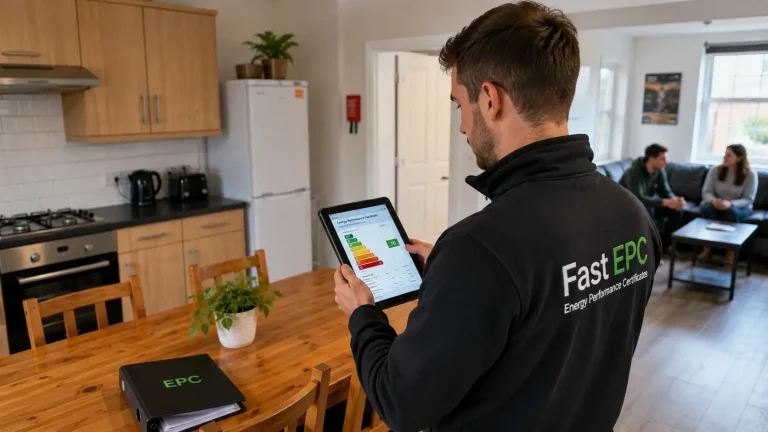

Whether an HMO needs an EPC currently depends partly on how the property is let. If the whole HMO is rented under a single tenancy, an EPC is generally required. Where individual rooms are let separately and tenants share facilities, the current position can be different. However, the Government has confirmed plans to change the rules so that a valid EPC would be required for the whole HMO when even one room is rented out. Those changes are part of wider EPC reforms and should not be treated as already in force until the legislation takes effect.
If you own a House in Multiple Occupation, one of the most confusing questions is:
Does my HMO need an EPC?
The answer is not always as simple as it is for a normal rented flat or house.
It can depend on:
- whether the whole property is rented under one tenancy;
- whether rooms are rented individually;
- whether any units are self-contained;
- whether an existing EPC is still valid;
- whether the property has previously been sold or let as a whole;
- and whether new EPC regulations have come into force.
This distinction is particularly important for London landlords, where HMOs, room lets, converted houses and mixed accommodation are common.
Fast EPC provides domestic EPC assessments throughout London, including larger shared houses and HMOs.
If you are unsure whether your property currently needs an EPC, or want to obtain one ahead of future regulatory changes, you can book an assessment online or contact Fast EPC directly.
What is an HMO?
HMO stands for House in Multiple Occupation.
Broadly, a property can be an HMO where it is occupied by at least three people who form more than one household and share facilities such as:
- a kitchen;
- bathroom;
- toilet.
A typical example would be a house occupied by unrelated tenants who each rent a bedroom but share the kitchen and bathroom.
A large HMO will generally require mandatory licensing where it is occupied by five or more people forming more than one household and at least one tenant pays rent.
Smaller HMOs may also require a licence depending on the rules operated by the local council.
HMO licensing and EPC requirements are separate.
Having an HMO licence does not automatically tell you whether an EPC is required.
Likewise, obtaining an EPC does not remove the need to comply with HMO licensing, electrical safety, fire safety or other landlord obligations.
Do HMOs currently need an EPC?
Sometimes.
The important issue is how the accommodation is rented.
Under the current position, there is a significant difference between:
- renting the entire property under one tenancy; and
- renting individual rooms under separate agreements.
This distinction is often missed by landlords.
HMO rented as one whole property
Suppose four students jointly rent a house.
They sign one tenancy agreement covering the entire property.
In that situation, the property is being let as a dwelling.
An EPC will generally be required for the whole property.
The landlord should normally make the EPC available to prospective tenants when required.
HMO rooms rented individually
Now consider a six-bedroom HMO.
Each tenant has their own agreement for one bedroom and everyone shares:
- the kitchen;
- bathroom;
- hallways;
- living area.
Under current guidance, an EPC has generally not been required purely because an individual non-self-contained room is rented.
Government guidance has specifically recognised this gap and is now planning to change it.
That means landlords should be careful when reading statements online saying:
“Every HMO must already have an EPC.”
That is too broad.
But the opposite statement:
“HMOs never need an EPC.”
is also wrong.
The tenancy arrangement and property configuration matter.
Do I need an EPC if I rent HMO rooms separately?
Under the current rules, where individual bedrooms are rented separately and occupants share facilities such as a kitchen or bathroom, an EPC has generally not been triggered simply by letting one of those rooms.
Current local authority guidance also distinguishes individual room lets from whole-house lettings.
For example, accommodation comprising bedsits or individual room lets with shared facilities may currently fall outside the EPC requirement, while a whole shared house let under one tenancy normally requires an EPC.
However, this is exactly the area the Government intends to change.
Are the HMO EPC rules changing?
Yes.
This is one of the most important EPC developments for HMO landlords in 2026.
The Government has confirmed that it intends to amend the Energy Performance of Buildings regime so that a valid EPC will be required for an entire HMO when a single room is rented out.
The stated aim is to remove the current difference between room-by-room HMO lettings and other private rented homes.
This could bring many properties into EPC requirements that have historically not needed a certificate when rooms were rented separately.
However, landlords need to distinguish between:
Government policy
and
law already in force.
The reforms require regulatory changes and parliamentary approval.
Until those changes legally take effect, landlords should not assume that every proposed EPC reform is already enforceable.
Fast EPC will continue to monitor the legislation as the new EPC regime develops.
What would the new HMO EPC rules mean?
Once implemented as planned, the change would mean that letting an individual room could trigger the requirement for an EPC covering the whole HMO.
Consider this example.
A landlord owns a five-bedroom HMO.
Each bedroom is rented separately.
All tenants share the kitchen and bathrooms.
Historically, the landlord may not have needed an EPC simply because individual rooms were being marketed and let.
Under the Government’s proposed new approach, letting even one room would require a valid EPC for the whole property.
This would remove one of the main differences between HMOs and conventional private rented homes.
Why is the Government changing the HMO EPC rules?
The Government has said the change is intended to create greater consistency across the private rented sector.
At present, two similar buildings can potentially be treated differently simply because the tenancy agreements are structured differently.
For example:
Property A
Five tenants rent the whole house under one joint tenancy.
An EPC is generally required.
Property B
Five tenants occupy an almost identical house, but each rents one room separately.
Under the current arrangements, the individual room lettings may not trigger an EPC for the whole HMO.
The proposed reform is intended to remove that distinction.
It would also potentially bring more HMOs within the Minimum Energy Efficiency Standards regime.
What EPC rating does a rented HMO need?
Where a rented domestic property falls within current MEES requirements, the present minimum standard is generally EPC E.
Relevant privately rented domestic properties with an EPC rating of F or G generally cannot be let or continue to be let unless a valid exemption applies.
That means an EPC result can have consequences beyond simply obtaining a certificate.
A landlord may receive:
- A;
- B;
- C;
- D;
- E;
- F;
- G.
Under the current domestic MEES regime:
| EPC rating | Current rental position |
|---|---|
| A | Generally compliant |
| B | Generally compliant |
| C | Generally compliant |
| D | Generally compliant |
| E | Current minimum in most cases |
| F | Normally sub-standard unless exempt |
| G | Normally sub-standard unless exempt |
The current minimum remains E unless the property qualifies for an exemption.
Will HMOs need EPC C?
The Government is also changing the longer-term energy-efficiency rules for privately rented homes.
Plans announced in 2026 include an intended future requirement for relevant private rented homes to reach EPC C or an equivalent standard by 1 October 2030, subject to the necessary legislation.
Landlords should therefore separate two questions:
What do I legally need today?
and:
What standard might I need to meet by 2030?
The current minimum for applicable privately rented domestic property remains EPC E.
Future EPC C requirements should not be described as though they are already the current minimum.
For HMO owners, however, the combination of wider HMO EPC coverage and higher future energy standards means early planning may be sensible.
Does every bedroom in an HMO need a separate EPC?
Usually not.
An EPC assessment is generally concerned with the relevant dwelling or building rather than producing one certificate for every non-self-contained bedroom.
Where a whole HMO EPC is required, the intention of the proposed reforms is for the EPC to cover the whole HMO.
That does not mean a six-bedroom shared house would automatically require six separate EPC certificates.
However, the situation can be different where the property contains genuinely self-contained flats.
What if my HMO contains self-contained flats?
This is where the configuration of the building becomes particularly important.
Suppose a converted house contains:
- two self-contained flats;
- three separate bedsits;
- shared common areas.
A self-contained flat with its own:
- kitchen;
- bathroom;
- living facilities;
- entrance arrangements
may be treated differently from a bedroom or bedsit that relies on shared facilities.
Current guidance indicates that self-contained units can require their own EPCs even where other non-self-contained areas do not.
Converted buildings should therefore be considered based on their actual layout rather than simply being labelled an “HMO”.
Does an HMO licence replace an EPC?
No.
An HMO licence and an Energy Performance Certificate serve completely different purposes.
An HMO licence primarily concerns issues such as:
- property management;
- number of occupants;
- room standards;
- fire precautions;
- safety;
- suitability of the accommodation.
An EPC assesses energy performance.
Depending on the property, a landlord may need:
- HMO licence;
- EPC;
- gas safety certificate;
- electrical inspection;
- smoke and carbon-monoxide alarms;
- fire-safety measures;
- other local licensing documentation.
Obtaining one does not automatically satisfy the others.
Do I need an EPC to apply for an HMO licence?
This can depend on the local authority and the circumstances.
Councils operate HMO licensing schemes and may request documentation when processing an application or renewal.
Local rules can also go beyond the minimum national licensing requirements in certain respects.
Landlords should therefore check the requirements of the council where the HMO is located.
This is particularly important in London because different boroughs can operate:
- mandatory licensing;
- additional HMO licensing;
- selective licensing.
Do not assume that the process used by one London borough will be identical in another.
Does an HMO EPC last ten years?
A domestic EPC is generally valid for ten years.
If an HMO already has a valid EPC, the landlord should check:
- the issue date;
- the current rating;
- whether the certificate relates to the present property configuration;
- whether substantial alterations have been made.
A ten-year-old certificate does not renew automatically.
Once it expires, another assessment may be needed where an EPC requirement applies.
My HMO already has an EPC. Do I need another one?
Not necessarily.
If the EPC is still valid and accurately relates to the property being let, it may continue to be usable.
However, consider commissioning another assessment if:
- the certificate has expired;
- the HMO has been substantially altered;
- bedrooms have been added;
- a loft has been converted;
- the layout has changed;
- self-contained units have been created;
- heating has been replaced;
- insulation has been installed;
- the property has undergone major refurbishment;
- you need to establish its current energy rating.
Remember that an existing EPC does not automatically update after improvements.
If your HMO received an EPC D several years ago and you have since installed:
- loft insulation;
- double glazing;
- a modern boiler;
- heating controls;
- solar panels,
the lodged certificate will still show the result recorded when the previous assessment was carried out.
A new EPC is required if you want the property reassessed in its current condition.
What happens if my HMO gets EPC F or G?
An F or G rating requires careful attention where the property falls within domestic MEES.
Do not assume that obtaining the certificate itself makes the property compliant.
The landlord may need to:
- review the EPC recommendations;
- establish which improvements are relevant;
- carry out applicable improvements;
- arrange reassessment where appropriate;
- register a valid exemption if the property qualifies.
The current domestic MEES framework includes specific exemptions and evidence requirements.
These can include circumstances involving:
- the applicable improvement cost cap;
- all relevant improvements having been made;
- wall insulation issues;
- inability to obtain necessary third-party consent;
- potential property devaluation.
Exemptions must normally be registered where required rather than simply being claimed privately by the landlord.
Is there a spending cap for improving an HMO?
Under the current domestic MEES regime, the relevant cost cap is generally £3,500 including VAT for improvements required to bring a qualifying privately rented property up to EPC E.
This is a domestic rule.
It should not be confused with commercial MEES, which operates differently.
Where all relevant improvements have been made within the applicable requirements and a property remains below E, the landlord may need to consider whether an exemption is available.
Evidence is important.
Keep:
- quotations;
- invoices;
- installer information;
- photographs;
- correspondence;
- reports;
- certificates.
Do not wait until an enforcement enquiry to start gathering paperwork.
Can I rent an HMO with EPC F?
Where the property is legally required to comply with domestic MEES, an F-rated property generally cannot be let or continue to be let unless a valid exemption applies.
However, because some room-by-room HMOs have historically fallen outside the EPC requirement, the precise position can depend on how the property is occupied and let.
This is another reason the planned HMO reforms matter.
Once the new EPC requirement is extended to individual room lettings as intended, more HMO landlords are likely to need to establish their property’s energy rating.
Can I rent an HMO with EPC G?
The same principle applies.
Where domestic MEES applies, EPC G is below the current minimum E standard.
The landlord may need to carry out eligible improvements or register an applicable exemption before the property can lawfully be let under those rules.
Do student HMOs need an EPC?
Student accommodation is a common area of confusion.
If a group of students rent an entire house together under a joint tenancy, an EPC will generally be required in the same way as other whole-property lettings.
If students rent individual bedrooms separately and share facilities, the current room-let distinction can apply.
The planned reforms would remove much of that distinction by requiring an EPC for the whole HMO when a single room is let.
Landlords should therefore avoid assuming that “student accommodation” automatically creates an EPC exemption.
The tenancy arrangement matters.
Do professional house shares need an EPC?
Again, look at how the property is let.
A house shared by four professionals under one joint tenancy is different from a property where four professionals each rent a bedroom separately.
The type of tenants does not by itself determine the EPC requirement.
What matters includes:
- tenancy structure;
- property layout;
- self-contained accommodation;
- relevant EPC regulations.
Does a bedsit need an EPC?
It depends on whether it is genuinely self-contained.
A bedroom or bedsit that relies on a shared kitchen or bathroom has historically been treated differently from a self-contained flat.
A self-contained unit can require its own EPC.
Landlords should be particularly careful with converted Victorian and Edwardian properties where the physical layout may have changed repeatedly over time.
The name used in a tenancy agreement does not necessarily determine how the building should be assessed.
Do serviced HMOs need an EPC?
Short-term and serviced accommodation is another area affected by wider EPC reforms.
The Government has announced plans to clarify and broaden EPC requirements for short-term rental properties as part of the reformed Energy Performance of Buildings regime.
The precise position can depend on how the accommodation is used and marketed.
Owners operating properties as:
- short-term lets;
- serviced accommodation;
- HMOs;
- holiday accommodation
should not assume that rules applying to a conventional six or twelve-month tenancy automatically apply in exactly the same way.
What does an EPC assessor inspect in an HMO?
An EPC assessment looks at the energy-related characteristics of the property.
Depending on the building, the assessor may consider:
- age and construction;
- external walls;
- roof;
- loft insulation;
- windows;
- glazing;
- doors;
- heating system;
- heating controls;
- hot-water system;
- lighting;
- floor construction;
- renewable-energy systems;
- extensions;
- room-in-roof areas;
- conservatories;
- solar PV;
- heat pumps.
An EPC is not a structural survey.
It is also not an HMO licensing inspection or electrical inspection.
Should I get an EPC now if my room-let HMO does not currently need one?
There can be practical reasons to do so.
The Government has already confirmed its intention to extend EPC requirements to whole HMOs when individual rooms are let.
Obtaining an EPC can therefore show you where the property currently stands before future rules take effect.
For example, an assessment could reveal that the HMO is already:
EPC C
That would give the landlord useful information for future planning.
Alternatively, it could reveal:
EPC F
That result would give the landlord time to investigate improvements rather than discovering the issue immediately before a future compliance deadline.
There is no need to carry out unnecessary work simply because reforms are proposed.
But knowing the property’s current position can make future decisions easier.
EPC evidence for HMO landlords
HMOs are frequently refurbished.
Bedrooms are added.
Lofts are converted.
Heating systems are altered.
Fire-protection work can involve new ceilings and walls.
Insulation may become hidden.
Keep evidence whenever energy-related improvements are carried out.
Useful documentation can include:
- insulation invoices;
- dated photographs;
- boiler installation certificates;
- window specifications;
- Building Regulations documents;
- solar installation records;
- heat-pump information;
- architectural drawings;
- guarantees;
- completion certificates.
This evidence can be valuable where the assessor cannot directly inspect a concealed feature.
What if I convert a normal house into an HMO?
Converting a dwelling into an HMO can involve much more than EPC requirements.
Depending on the property and local authority, you may need to consider:
- planning permission;
- HMO licensing;
- Building Regulations;
- fire safety;
- electrical safety;
- room-size requirements;
- amenity standards;
- waste-storage requirements;
- EPC requirements.
The existing EPC may still be within its ten-year validity period, but substantial building alterations do not automatically update that certificate.
If an extension, loft conversion or major refurbishment has changed the property considerably, it can be sensible to establish whether a new assessment is appropriate.
What if I convert an HMO back into a normal house?
Again, the property’s use and configuration matter.
If the HMO is converted back into a conventional dwelling and subsequently sold or rented, the normal EPC requirements for residential property may apply.
If major works were involved, an old EPC produced before the conversion may no longer provide a useful representation of the finished property.
HMO EPC rules in London
London has a particularly large private rented sector and many properties operate as:
- shared houses;
- bedsits;
- student HMOs;
- professional house shares;
- converted houses;
- flats above commercial premises.
Landlords must consider both national EPC legislation and local licensing rules.
Different London councils may operate different HMO or selective licensing schemes.
Fast EPC carries out EPC assessments throughout London and can assess larger domestic properties including HMOs.
HMO EPC checklist for landlords
Before letting or renewing HMO accommodation, check:
- Is the whole property rented under one tenancy?
- Are bedrooms rented separately?
- Are any units self-contained?
- Does the property already have an EPC?
- Is that EPC still valid?
- What rating does it show?
- Has the property been substantially altered?
- Has insulation or heating been upgraded?
- Do you have evidence of improvements?
- Does the property need an HMO licence?
- Does your council operate additional licensing?
- Are future EPC reforms relevant to your letting model?
Answering these questions early can prevent problems later.
Frequently Asked Questions
Does every HMO need an EPC in 2026?
Not under the current rules in every situation. A whole property rented under one tenancy will generally require an EPC, while individual room lets with shared facilities have historically been treated differently. The Government intends to change the rules so a whole HMO needs an EPC when a single room is let.
Does each HMO bedroom need an EPC?
Normally no. Non-self-contained bedrooms would not usually each receive separate EPCs. Where the proposed HMO requirement applies, the intention is for an EPC covering the whole HMO.
Does a five-bedroom HMO need an EPC?
Potentially. The number of bedrooms alone does not determine the EPC requirement. How the property is let and configured matters.
Does a six-bedroom HMO need an EPC?
The same principle applies. A six-bedroom property rented under a single tenancy would generally require an EPC. Separate room lettings are currently treated differently, although planned reforms are expected to change this.
Does an HMO EPC last ten years?
Domestic EPCs are generally valid for ten years.
What is the minimum EPC rating for an HMO?
Where domestic MEES applies, the current minimum is generally EPC E unless a valid exemption applies.
Will HMO landlords need EPC C by 2030?
The Government intends to introduce higher energy-efficiency requirements for privately rented homes, with 1 October 2030 identified as the intended compliance date for new and existing relevant private rented properties. The legislative changes remain subject to the required approval and implementation.
Does an HMO licence mean I already have an EPC?
No. They are separate requirements.
Can Fast EPC assess an HMO?
Yes. Fast EPC provides domestic EPC assessments for larger properties and HMOs throughout London.
Book an HMO EPC in London
If you own or manage an HMO in London and want to establish its current energy rating, Fast EPC can arrange a professional EPC assessment.
We work with:
- HMO landlords;
- property investors;
- letting agents;
- managing agents;
- portfolio landlords;
- property developers;
- homeowners.
Whether you have:
- a student HMO;
- professional house share;
- converted property;
- large shared house;
- multi-bedroom rental,
we can assess the property and lodge the EPC on the official register where applicable.
With HMO EPC rules expected to change as part of the wider 2026 Energy Performance of Buildings reforms, landlords with room-by-room rentals should pay particular attention to the new requirements as legislation develops.
Book your HMO EPC with Fast EPC today or call us to discuss your property.
This article provides general information about EPC requirements in England and Wales as at August 2026. HMO licensing, planning and EPC requirements can depend on the property, tenancy arrangement and local authority. Government EPC reforms referred to above may require further legislation before taking effect.