
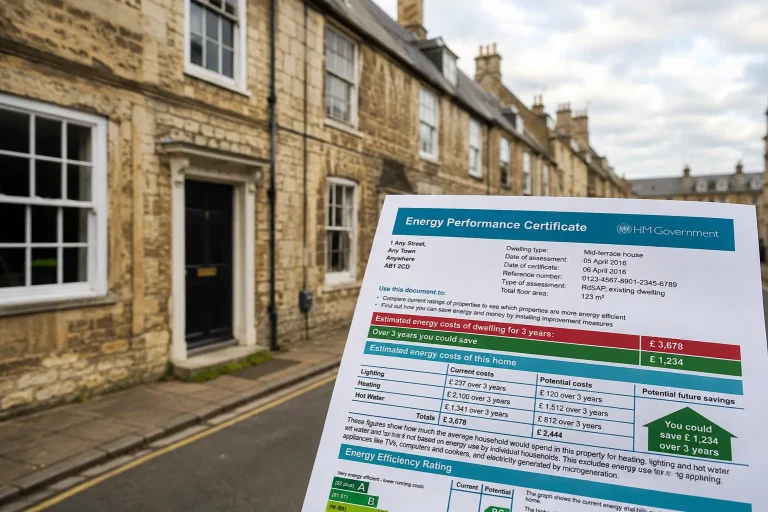

Owning, selling or letting a listed property can be confusing enough without conflicting advice about Energy Performance Certificates.
Some owners are told:
“Listed buildings are automatically exempt from EPCs.”
Others are told they must obtain an EPC before an estate agent can market the property.
Neither statement is reliable in every case.
A listed building may be exempt where complying with certain minimum energy-performance requirements would unacceptably alter its architectural or historic character. However, being Grade I, Grade II* or Grade II does not necessarily create an automatic exemption.
The position depends on the individual property, its protected features, the reason an EPC would normally be required and the effect that energy-efficiency improvements could have on its character.
This guide explains the rules for listed buildings in plain English, including:
- selling a listed property;
- letting a listed home;
- EPC ratings of F or G;
- Minimum Energy Efficiency Standards;
- Grade I, Grade II* and Grade II properties;
- homes in conservation areas;
- suitable improvements for historic buildings;
- exemptions and supporting evidence.
For advice about an EPC for a listed or historic property in London, contact Fast EPC before marketing the building or beginning improvement work.
Do listed buildings need an EPC?
A listed building is not automatically exempt from needing an EPC. An exemption may apply where meeting minimum energy-performance requirements would unacceptably alter the property’s architectural or historic character or appearance. Each building should therefore be considered individually.
An EPC is normally required when a qualifying property is:
- built;
- sold;
- marketed for sale;
- rented out;
- marketed to prospective tenants.
Listed buildings and certain other officially protected buildings receive special consideration because standard energy improvements may damage historically important features.
The exemption is conditional. It should not be treated as a blanket rule covering every listed property.
Historic England describes the exemption using the same test: whether compliance with minimum energy-performance requirements would unacceptably alter the building’s character or appearance.
Listed building EPC rules at a glance
| Property or situation | Likely EPC position |
|---|---|
| Grade II listed home being sold | An EPC may be required unless the conditional exemption applies |
| Grade I or Grade II* building | Not automatically exempt because of its grade |
| Listed property being rented | EPC and MEES rules must be considered |
| Listed rental property rated F or G | Improvements or an appropriate registered exemption may be required |
| Unlisted property in a conservation area | Not automatically exempt |
| Historic building with no official protection | Normal EPC requirements generally apply |
| Listed property with an existing valid EPC | The EPC can normally remain valid until it expires |
| Owner-occupied listed home not being sold or rented | A new EPC may not currently be triggered |
| Listed commercial property | Separate non-domestic EPC and MEES rules may apply |
An EPC is normally valid for ten years, although owners can commission a new assessment sooner, particularly after substantial improvements.
Why are listed building EPC rules so confusing?
The confusion comes from the wording of the exemption.
It applies to certain officially protected buildings:
in so far as compliance with certain minimum energy-performance requirements would unacceptably alter their character or appearance.
That wording is sometimes shortened online to:
“Listed buildings do not need EPCs.”
But those two statements do not mean the same thing.
The exemption depends on the consequences of complying with the relevant requirements. It does not necessarily depend on the property’s listed status alone.
For example, an EPC might recommend replacing original single-glazed sash windows. That change could be unacceptable in a protected Georgian townhouse.
The same EPC might also recommend:
- heating controls;
- low-energy lighting;
- loft insulation;
- draught-proofing;
- pipe insulation.
Some of those measures may be possible without damaging the property’s special interest.
That is why the answer must be based on the actual building rather than a general assumption about all listed properties.
Are Grade II listed buildings exempt from EPCs?
Grade II listed buildings are not automatically exempt from EPC requirements. The conditional exemption may apply where meeting relevant energy-performance requirements would cause an unacceptable change to the building’s historic character or appearance.
Grade II is the most common listing category in England.
A Grade II property may contain protected features such as:
- original sash or casement windows;
- historic timber doors;
- decorative plasterwork;
- fireplaces and chimney breasts;
- stone, cob or solid-brick walls;
- lime plaster or lime mortar;
- historic roof structures;
- traditional shopfronts;
- original floorboards;
- architecturally important interiors.
Replacing or covering these features could harm the reason the building was listed.
However, many Grade II buildings can still accommodate carefully selected improvements. Listing does not mean that every part of the property must remain unchanged forever.
What is the difference between Grade I, Grade II* and Grade II?
Listed buildings in England are placed into three principal categories.
| Listing grade | Meaning | Automatic EPC exemption? |
|---|---|---|
| Grade I | Buildings of exceptional interest | No |
| Grade II* | Particularly important buildings of more than special interest | No |
| Grade II | Buildings of special architectural or historic interest | No |
A higher listing grade normally indicates greater heritage significance. It may therefore be more difficult to obtain permission for intrusive work.
But the EPC exemption test remains focused on whether compliance would unacceptably alter the building’s protected character or appearance.
The listing grade alone does not provide the complete answer.
Does a property in a conservation area need an EPC?
Being inside a conservation area does not automatically exempt a property from needing an EPC. An exemption may only be relevant where complying with minimum energy-performance requirements would unacceptably alter the building’s character or appearance.
A conservation area and a listed building are not the same thing.
Listed building
A listed building is individually designated because of its architectural or historic importance.
Protection can apply to:
- its exterior;
- its interior;
- attached structures;
- historically associated features within its curtilage.
Conservation area
A conservation area protects the special character or appearance of a wider place, such as:
- a historic town centre;
- a Victorian residential street;
- a garden suburb;
- an old industrial quarter;
- a village centre.
A property can therefore be:
- listed and inside a conservation area;
- listed but outside a conservation area;
- unlisted but inside a conservation area;
- neither listed nor within a conservation area.
Official local-authority guidance confirms that properties in conservation areas are not covered by a blanket EPC exemption.
Listed building versus conservation-area property
| Question | Listed building | Conservation-area property |
|---|---|---|
| Is the individual building protected? | Yes | Not necessarily |
| Can internal alterations be controlled? | Often | Usually less extensively unless separately listed |
| Can external changes be restricted? | Yes | Yes |
| Is listed building consent relevant? | Potentially | Only if the building is also listed |
| May planning permission be required? | Yes | Yes |
| Is it automatically exempt from an EPC? | No | No |
Always check the individual property rather than assuming every building on the same street has the same status.
Does a listed building need an EPC when being sold?
Most qualifying properties require an EPC before being marketed for sale.
An owner of a listed property should establish whether:
- the property already has a valid EPC;
- the property is officially listed or subject to another form of protection;
- the conditional exemption genuinely applies;
- the estate agent requires supporting information;
- the conveyancing solicitor is satisfied with the position.
A seller should not wait until a buyer has made an offer before investigating the issue.
Uncertainty can create delays during:
- preparation of sales particulars;
- conveyancing enquiries;
- mortgage valuation;
- buyer due diligence;
- exchange of contracts.
Can an estate agent market a listed building without an EPC?
Possibly, where the property falls outside the EPC requirement because a valid exemption applies.
However, an estate agent may reasonably ask the seller to provide evidence explaining why an EPC is not required.
An agent is unlikely to accept “the property is Grade II listed” as sufficient proof without further consideration.
The safest approach is to investigate the issue before the property is advertised.
Does a listed building need an EPC when rented?
A listed rental property may need an EPC unless the relevant conditional exemption applies.
Where the building requires an EPC, the landlord must also consider the Minimum Energy Efficiency Standards, commonly known as MEES.
In England and Wales, most privately rented domestic properties that fall within the regime must currently achieve at least an EPC rating of E unless a valid exemption applies. Government guidance was updated in May 2026 and continues to identify E as the current minimum domestic standard.
This creates two separate questions:
- Does the building need an EPC?
- If it does, does its rating meet the minimum letting standard?
These questions should not be combined into one.
EPC exemption versus MEES exemption
This distinction is important.
EPC exemption
This concerns whether the building must obtain an Energy Performance Certificate in the first place.
MEES exemption
This concerns whether a rented property that falls within the EPC and MEES regime can legally continue to be let despite not meeting the required rating.
| Exemption | What it relates to |
|---|---|
| EPC exemption | Whether an EPC is required |
| MEES exemption | Whether a substandard rental property can lawfully be let |
| Listed building consent | Whether physical alterations can be made |
| Planning permission | Whether proposed development or external changes are permitted |
A landlord should not assume that an informal view about the building’s historic character automatically registers a MEES exemption.
Where registration is required, evidence must be provided through the official Private Rented Sector Exemptions Register.
Government guidance states that registered exemptions generally last five years. After expiry, the landlord must reassess whether improvements can be carried out or whether a further exemption is justified.
What happens if a listed rental property has an F or G rating?
A privately rented property with an EPC rating of F or G may be considered substandard under the current MEES rules.
The landlord may need to:
- review the EPC recommendations;
- identify which improvements are suitable;
- obtain any necessary professional or conservation advice;
- carry out permitted qualifying improvements;
- commission a new EPC where appropriate;
- register a valid exemption if the rating cannot lawfully or reasonably be improved.
The fact that one recommendation is unsuitable does not necessarily mean every possible improvement can be disregarded.
For example, replacing original windows may be unacceptable, while improving heating controls may still be reasonable.
Does the end of Section 21 remove the EPC requirement?
No.
Section 21 “no-fault” evictions were abolished in England from 1 May 2026 under the Renters’ Rights Act reforms. That change did not abolish EPC or MEES obligations.
Landlords must still maintain an appropriate compliance record, including relevant:
- EPC documentation;
- MEES exemptions;
- gas-safety records;
- electrical-safety records;
- deposit protection;
- tenancy documentation.
Because tenancy and possession law is separate from EPC law, landlords should seek specialist legal advice regarding possession proceedings.
Who decides whether the listed building exemption applies?
This is another area where online guidance is often unclear.
The EPC assessor
An accredited assessor inspects the property and produces an EPC using the applicable assessment methodology.
The assessor records matters such as:
- building age and construction;
- walls, roofs and floors;
- windows and glazing;
- heating and hot-water systems;
- lighting;
- insulation;
- ventilation;
- renewable technologies.
An EPC assessor does not grant listed building consent.
The conservation officer
A local-authority conservation officer may advise how proposed work could affect the building’s architectural or historic significance.
Their input can be particularly valuable when considering:
- replacement windows;
- internal or external insulation;
- solar panels;
- alterations to historic roofs;
- new heating equipment;
- changes to façades;
- removal of historic fabric.
The local planning authority
The local planning authority determines applications for listed building consent and planning permission.
The owner or landlord
The owner remains responsible for understanding and meeting the applicable legal obligations.
The solicitor or letting agent
Solicitors and agents may request evidence, but they do not normally determine whether proposed alterations are acceptable from a heritage-planning perspective.
What evidence should an owner keep?
Where an owner or landlord relies on an exemption, it is sensible to retain a clear paper trail.
Depending on the circumstances, this may include:
- the property’s official list entry;
- an existing EPC;
- the EPC recommendation report;
- photographs of protected features;
- advice from a conservation officer;
- listed building consent decisions;
- reports from a surveyor or heritage specialist;
- contractor quotations;
- evidence submitted to the PRS Exemptions Register;
- correspondence with the local authority;
- records of suitable improvements already completed.
Do not rely entirely on a verbal conversation that cannot be verified later.
Can listed buildings be made more energy efficient?
Yes.
Historic buildings are not necessarily inefficient by definition, and listing does not prevent all improvement.
The right approach is normally to understand how the building was constructed before selecting measures.
Many older properties use traditional materials that manage heat and moisture differently from modern cavity-wall homes.
Inappropriate work can cause:
- condensation;
- trapped moisture;
- timber decay;
- mould;
- damaged masonry;
- failed plaster;
- reduced ventilation;
- loss of historic fabric.
Historic England advises that improvements should take account of the building’s construction, significance and moisture behaviour rather than applying standard modern solutions without investigation.
Energy improvements that may be suitable
Every property is different, but possible measures can include:
Draught-proofing
Carefully installed draught-proofing can reduce uncontrolled air leakage around:
- windows;
- doors;
- suspended floors;
- loft hatches.
It should not block ventilation needed to control moisture.
Secondary glazing
Secondary glazing can sometimes improve comfort and reduce heat loss while retaining original windows.
Its acceptability depends on:
- fixing methods;
- visibility;
- frame design;
- impact on shutters or architraves;
- the importance of the existing windows.
Loft insulation
Insulating an accessible roof space can be relatively unobtrusive, although ventilation and moisture movement must be considered.
Heating controls
Modern controls may improve energy use without major changes to historic fabric.
Examples include:
- room thermostats;
- thermostatic radiator valves;
- weather compensation;
- zoned heating;
- improved time controls.
Boiler or heating-system improvements
A more efficient heating system may improve the EPC rating, but the effect depends on the complete building.
The positioning of:
- flues;
- external units;
- pipework;
- radiators;
- controls
may require careful planning.
Low-energy lighting
Replacing suitable lamps with efficient alternatives is usually less intrusive than structural changes.
Pipe and cylinder insulation
Insulating accessible hot-water pipes and cylinders can reduce heat loss without substantially affecting the building’s appearance.
Improvements that need particular care
The following measures may significantly affect historic character or building fabric:
- replacing original windows;
- external wall insulation;
- internal wall insulation;
- spray-foam roof insulation;
- replacing historic doors;
- covering decorative masonry;
- removing fireplaces;
- installing visible solar panels;
- altering rooflines;
- adding external heat-pump equipment;
- using impermeable materials on traditionally breathable walls.
These measures are not automatically prohibited, but professional advice and consent may be necessary.
Do EPC recommendations have to be completed?
An EPC recommendation report identifies ways the property’s modelled energy performance could potentially be improved.
It is not, by itself, permission to carry out the work.
An EPC recommendation does not override:
- listed building legislation;
- planning controls;
- Building Regulations;
- lease restrictions;
- freeholder consent;
- party-wall requirements;
- structural or moisture considerations.
Owners should not order major work solely because it appears on an EPC.
Would replacing original windows be acceptable?
Not necessarily.
Original windows can be central to the character of a listed building.
Replacing them with uPVC or an inappropriate modern design may:
- alter frame proportions;
- change reflections;
- remove historic glass;
- damage surrounding fabric;
- affect the external appearance;
- require listed building consent.
Possible alternatives could include:
- careful repair;
- draught-proofing;
- secondary glazing;
- shutters;
- suitable curtains or blinds.
The correct approach depends on the significance and condition of the existing windows.
Are solar panels allowed on listed buildings?
Solar panels are not automatically prohibited on every listed building.
Their acceptability may depend on:
- visibility from public viewpoints;
- roof significance;
- fixing methods;
- impact on historic materials;
- surrounding conservation context;
- alternative locations;
- reversibility.
Listed building consent and planning permission may be required.
A less prominent roof slope, outbuilding or ground-mounted installation may sometimes reduce heritage impact, but each case must be considered individually.
Can a heat pump be installed at a listed property?
Potentially, but factors include:
- location of the outdoor unit;
- noise;
- visible pipework;
- alterations to walls;
- radiator sizes;
- internal equipment;
- electricity supply;
- the building’s heat loss;
- planning and listed building consent.
Installing a heat pump does not guarantee a better EPC rating. Its effect depends on the building, fuel type, system specification and the assessment methodology.
Real-world examples
Example 1: Grade II Georgian terrace in South London
The property has original timber sash windows, solid-brick walls and decorative shutters.
Replacing the windows with uPVC could significantly alter its character. However, secondary glazing, roof insulation and heating controls may be possible.
The owner should not assume that the whole property is EPC exempt simply because one recommendation is inappropriate.
Example 2: Unlisted Victorian house in a conservation area
The property is not individually listed but sits within a protected streetscape.
Normal EPC requirements may still apply. Restrictions on external changes do not automatically remove the need for an EPC.
Example 3: Listed rental cottage rated F
The landlord receives recommendations for wall insulation, heating improvements and low-energy lighting.
External wall insulation may be unacceptable, but heating controls and lighting improvements may still be suitable.
The landlord should investigate permissible measures before relying on a MEES exemption.
Example 4: Listed shop with a flat above
The commercial unit and residential accommodation may have different EPC assessment and regulatory requirements.
The owner may need specialist advice to identify:
- which parts require certificates;
- whether separate assessments are needed;
- whether domestic or non-domestic MEES applies;
- how protected features affect recommended work.
Common listed building EPC myths
Myth: Every listed building is automatically exempt
Reality: The exemption is conditional and depends on the effect of compliance on the building’s character or appearance.
Myth: Grade II buildings never need EPCs
Reality: The listing grade does not create a blanket exemption.
Myth: Every home in a conservation area is exempt
Reality: Conservation-area status alone does not automatically remove EPC requirements.
Myth: An EPC assessor can approve alterations
Reality: EPC assessors assess energy performance. They do not grant planning permission or listed building consent.
Myth: Nothing can be changed in a listed building
Reality: Sensitive and appropriate improvements may be possible, although consent may be required.
Myth: Registering an exemption lasts forever
Reality: Many PRS exemptions generally last five years and must then be reconsidered.
Myth: EPC recommendations are compulsory building instructions
Reality: Recommendations should be considered alongside heritage, planning, technical and legal requirements.
A practical checklist before selling or letting
Before marketing a listed or historic property:
- Check whether the building is officially listed.
- Check whether it lies within a conservation area.
- Search the EPC register for an existing valid certificate.
- Identify why an EPC is being requested.
- Review the building’s protected features.
- Obtain advice where the exemption position is uncertain.
- Speak to the conservation officer before carrying out sensitive work.
- Keep written evidence of decisions and professional advice.
- Register a MEES exemption where legally required.
- Give the relevant documents to the estate or letting agent.
Frequently asked questions
Is a listed building automatically exempt from an EPC?
No. An exemption may apply where compliance with relevant minimum energy-performance requirements would unacceptably alter the building’s character or appearance.
Does a Grade II listed house need an EPC?
It may. Grade II status alone does not automatically decide the matter.
Does a Grade I building require an EPC?
Potentially. Grade I status indicates exceptional heritage importance but is not, by itself, a blanket EPC exemption.
Does a conservation-area property need an EPC?
Usually, unless the specific conditional exemption applies. Being located in a conservation area is not enough on its own.
Can I sell a listed property without an EPC?
Possibly, where the property genuinely falls within an exemption. Establish and document the position before marketing it.
Can I rent a listed building with an F or G rating?
Not normally where the property requires an EPC and falls within MEES, unless suitable improvements have been made or a valid exemption is registered.
Do I have to replace original windows because an EPC recommends it?
No. EPC recommendations do not override listed building controls. Speak to the local conservation officer before changing historically important windows.
Do I need listed building consent for insulation?
Possibly. It depends on the type of insulation, its location and its effect on the building’s fabric and character.
Can secondary glazing improve the EPC rating?
It may improve the modelled performance, but the exact effect depends on the property and how the measure is recorded.
Who can assess a listed property?
The EPC must be produced by an appropriately accredited domestic or non-domestic energy assessor, depending on the building.
How long is an EPC valid?
An EPC is generally valid for ten years unless replaced by a newer certificate.
How long does a MEES exemption last?
Many registered PRS exemptions generally last for five years. The relevant conditions and evidence should be checked for the specific exemption.
Are EPC rules the same throughout the UK?
No. England and Wales share the principal EPB framework discussed in this guide, while Scotland and Northern Ireland operate separate regimes. Owners outside England and Wales should follow the guidance applicable to that nation.
Can Fast EPC confirm whether planning permission is required?
An EPC assessor can explain the assessment and recommendations, but planning permission and listed building consent are determined through the relevant local planning authority.
Book an EPC for a listed property in London
Listed buildings need a more careful approach than modern properties, but the process does not have to be confusing.
Fast EPC provides professional EPC assessments across London for:
- homeowners;
- landlords;
- estate agents;
- property managers;
- commercial owners;
- buyers and sellers.
We can inspect the building, produce the relevant EPC where required and explain the recommendations clearly.
Where heritage or planning approval is involved, you should also consult the local authority’s conservation team or an appropriately qualified heritage professional.
Book your EPC assessment online or call Fast EPC to discuss your property before it is marketed.
This article provides general information for properties in England and Wales and is not legal, planning or conservation advice. Regulations and individual circumstances can differ, so obtain professional advice where necessary.