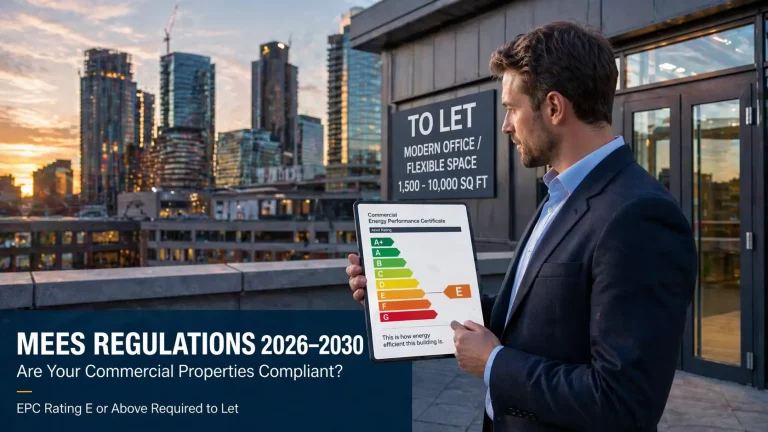

If you own or manage a commercial property in the UK, MEES regulations directly affect whether you can legally rent it.
Many landlords only look into MEES when:
- a tenant is leaving
- a new lease is being signed
- a property is being marketed
- an EPC rating is checked during a transaction
At that point, the key question becomes:
Can I still legally rent my commercial property with its current EPC rating?
This guide explains exactly what MEES regulations mean for commercial landlords, what’s changing, and what you need to do now.
If you need a Commercial EPC quickly, you can Book now or Call now to speak with an accredited assessor.
What Are MEES Regulations for Commercial Property?
MEES (Minimum Energy Efficiency Standards) are UK regulations that set the minimum EPC rating required for rented commercial properties.
Under current rules:
- Most commercial properties must have an EPC rating of E or above to be legally rented
- Properties rated F or G cannot normally be let
- These rules apply to most non-domestic buildings
MEES regulations are designed to improve energy efficiency and reduce carbon emissions across commercial buildings.
What Is the Minimum EPC Rating for Commercial Property?
The current legal minimum EPC rating for most rented commercial properties is E.
| EPC Rating | Can the property be rented? |
|---|---|
| A–E | Yes |
| F–G | No (unless exempt) |
If your property falls below E:
- you may need to improve the building
- you may need to register an exemption
- you may not legally be able to rent it
Can You Rent a Commercial Property With a Low EPC Rating?
No — in most cases, you cannot legally rent a commercial property with an EPC rating of F or G.
This applies when:
- granting a new lease
- renewing a lease
- continuing an existing tenancy
If the property does not meet MEES requirements, it may be considered non-compliant.
When Do MEES Regulations Apply?
MEES rules apply when a commercial property is:
- rented to a tenant
- leased under a new agreement
- undergoing lease renewal
- part of an ongoing tenancy
They do not usually apply if:
- the property is not being rented
- the building qualifies for a registered exemption
What Happens If Your Property Is Non-Compliant?
If a commercial property does not meet MEES standards, landlords may face:
- inability to legally rent the property
- enforcement action
- financial penalties
- delays in leasing or transactions
In practice, non-compliant properties can become difficult to let or refinance.
MEES Fines and Penalties (UK)
Penalties for non-compliance depend on the rateable value of the property.
| Rateable Value | Potential Penalty |
|---|---|
| Under £50,000 | Up to £50,000 |
| £50,000+ | Up to £150,000 |
Other consequences may include:
- public listing of non-compliance
- reputational impact
- forced compliance actions
Are MEES Rules Changing in 2027–2030?
Yes — future changes are expected.
Government policy indicates:
- stronger enforcement of existing rules
- potential tightening of minimum EPC standards
- long-term targets pushing buildings toward higher efficiency ratings
Many landlords are already preparing for stricter requirements before 2030.
Do You Need a New EPC for MEES Compliance?
In many cases, yes.
You may need a new EPC if:
- your current certificate has expired
- your rating is outdated
- improvements have been made to the building
- you are entering a new lease agreement
An updated EPC provides:
- an accurate rating
- compliance confirmation
- better positioning for future regulations
What If Your EPC Rating Is F or G?
If your commercial property has a low EPC rating, you have several options.
Option 1: Improve the Property
Common improvements include:
- upgrading lighting to LED
- improving insulation
- upgrading heating systems
- installing energy controls
These can often raise the EPC rating to E or above.
Option 2: Register an Exemption
Exemptions may apply if:
- improvements are not cost-effective
- required works are not technically feasible
- third-party consent cannot be obtained
Exemptions must be officially registered and are usually time-limited.
Option 3: Do Nothing (Risk)
Doing nothing can result in:
- inability to rent the property
- financial penalties
- reduced property value
How MEES Affects Commercial Property Value
MEES regulations now influence property value more than many landlords expect.
A compliant property:
- is easier to rent
- attracts more tenants
- supports financing and refinancing
A non-compliant property:
- may lose market value
- may require investment before leasing
- may face limited demand
How to Check If Your Property Meets MEES
To check compliance, you need to:
- Find your EPC certificate
- Check the current rating
- Confirm the expiry date
- Review improvement recommendations
If no EPC exists or the certificate is expired, a new assessment may be required.
How to Become MEES Compliant
Becoming compliant is usually straightforward.
Typical steps include:
- Arrange a Commercial EPC assessment
- Review the EPC rating and recommendations
- Complete necessary improvements (if required)
- Confirm compliance before leasing the property
Many properties can be brought into compliance with relatively simple upgrades.
How Long Does It Take to Get a Commercial EPC?
Typical timelines:
| Step | Time |
|---|---|
| Site survey | 30 minutes to several hours |
| Energy modelling | Same day or next day |
| Certificate issued | 24–48 hours |
Small commercial units can often be completed quickly.
Commercial EPC Cost (London Guide)
| Property Type | Typical Cost |
|---|---|
| Small commercial unit | £150 – £250 |
| Medium commercial property | £250 – £450 |
| Large building | £450+ |
Costs depend on:
- building size
- complexity
- number of zones
- systems installed
Frequently Asked Questions About MEES
What does MEES stand for?
Minimum Energy Efficiency Standards.
What is the minimum EPC rating for commercial property?
EPC rating E or above for most rented properties.
Can I rent a commercial property with EPC F?
No, unless an exemption is registered.
Do MEES rules apply to existing leases?
Yes, they can apply to ongoing tenancies.
Will EPC requirements change in the future?
Stricter regulations are expected as the UK moves toward higher efficiency targets.
Final Thought
MEES regulations are now a key part of commercial property compliance.
For landlords, the most important step is simple:
Know your EPC rating and act early.
Waiting until a lease or sale can lead to delays, lost income and compliance risks.
If you need a Commercial EPC in London, you can Book now, Get a fast quote, or Call now to speak with an accredited assessor.