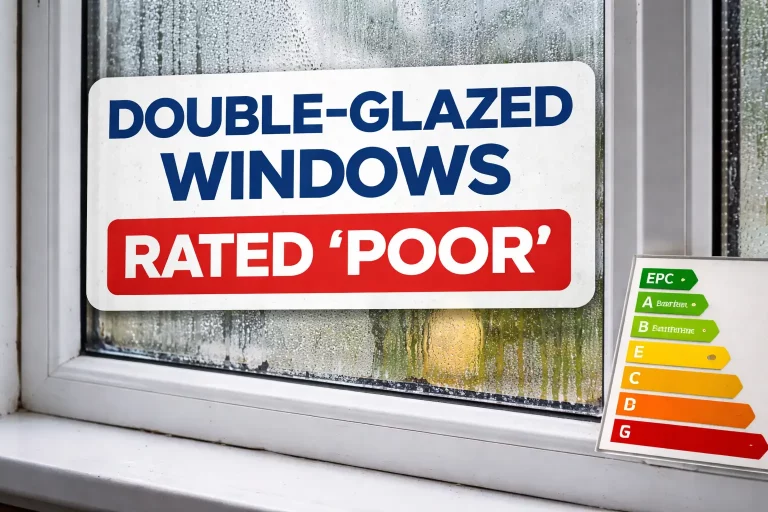

Many homeowners and landlords are shocked when their EPC shows double-glazed windows rated as “poor”.
Especially when the windows look modern.
Or were installed years ago at high cost.
This confusion has become much more common since the introduction of RdSAP 10.
This guide explains exactly why this happens, what the EPC is really saying, and what you can realistically do about it.
No jargon.
No assessor language.
Just clear answers.
Under RdSAP 10, double-glazed windows are often rated “poor” when their age or performance cannot be proven, or when they do not meet modern heat-loss standards. This reflects EPC calculation rules, not window safety or quality.
Double-glazed windows can be rated “poor” on an EPC under RdSAP 10 when their age or performance cannot be proven, or when they have higher heat-loss values (U-values) compared to modern standards. The rating reflects the EPC calculation model, not whether the windows are unsafe or unusable.
What is RdSAP 10?
RdSAP stands for Reduced Data Standard Assessment Procedure.
It is the method used to produce EPCs for existing homes in the UK.
RdSAP 10 is the latest version.
It changed how heat loss is calculated for several building elements, including:
Windows
Doors
Roofs
Ventilation
The goal is to make EPCs more accurate.
The side effect is that older or undocumented features now score lower.
Why windows matter so much on an EPC
Windows affect EPC scores because they allow heat to escape.
The EPC does not judge comfort.
It does not judge appearance.
It only measures heat loss.
This is mainly done using something called a U-value.
What is a U-value? (simple explanation)
A U-value measures how fast heat escapes through a material.
Lower U-value = better insulation
Higher U-value = more heat loss
Modern standards expect much lower U-values than in the past.
Many older double-glazed windows still have high U-values by today’s standards.
Window ratings explained (clear comparison)
Here is how windows are typically treated in EPC calculations:
| Window type | Typical EPC rating |
|---|---|
| Single glazing | Very poor |
| Old or unknown double glazing | Poor |
| Modern documented double glazing | Good |
| Triple glazing / very low U-value | Excellent |
Important point:
“Poor” does not mean broken or unsafe.
It means less efficient compared to current benchmarks.
Why double glazing is often marked “poor”
This usually happens for one of these reasons:
1. The window age is unknown
If the assessor cannot confirm:
Installation date
Specification
Certification
They must follow RdSAP conventions.
That usually means a default conservative assumption.
Conservative assumptions = lower EPC score.
🔹 Default Assumption Logic
This is one of the most misunderstood parts of EPCs.
Under RdSAP rules, assessors are not allowed to guess.
If there is no evidence proving the window’s age or performance, the assessor must assume the least efficient reasonable option for that window type.
This is called the default assumption.
Key points:
No certificate = no upgrade assumption
Visual condition does not override rules
“Looks new” is not evidence
The model always assumes higher heat loss without proof
This is why many EPC results feel harsh — the calculation is designed to be cautious.
2. The windows are older double glazing
Older double glazing often has:
Wider spacer bars
Less effective coatings
Weaker seals
Higher U-values
Even if they feel fine, the EPC model treats them as less efficient.
🔹 RdSAP 10 window categories explained (current rules)
Under RdSAP 10, double-glazed windows are recorded using specific evidence-based categories.
These are the options assessors must use:
Double glazing – unknown install date
Used when the property has double glazing but no proof of age or specification is available.
Default conservative assumptions apply, often resulting in a “poor” rating.
Double glazing installed before 2002
Reflects pre-Building Regulations standards.
Assumed higher heat loss and higher U-values.
Frequently rated “poor”.
Double glazing installed between 2002 and 2022
Improved regulatory standards and better assumed performance.
Requires evidence to be recorded.
Often rated “average” or “good”.
Double glazing installed during or after 2022
Modern glazing standards and lowest assumed U-values.
Typically rated “good”.
Double glazing – known data
Used when installation date and specification can be proven with documentation.
Allows more accurate EPC inputs and usually improves the window rating.
If no evidence is provided, the assessor must default to the least efficient reasonable category.
3. No supporting evidence was available
Without evidence, assessors cannot guess.
Acceptable evidence includes:
FENSA certificate
Building Control sign-off
Installer invoice
Manufacturer specification
Documentation showing installation year
No paperwork = default values.

“But my windows are double glazed — why is that not enough?”
This is the most common question.
Double glazing describes structure, not performance.
Two panes of glass alone do not guarantee:
Low heat loss
Modern coatings
Efficient frames
EPCs care about measured efficiency, not labels.
Did RdSAP 10 make this worse?
Yes — but intentionally.
RdSAP 10:
Uses tighter assumptions
Reduces overly generous defaults
Requires better evidence
Aligns closer to real-world heat loss
This is why many EPC results changed even when nothing physically changed in the property.
Does double glazing affect EPC ratings?
Yes.
Windows can significantly affect EPC results because:
They cover large surface areas
They contribute to heat loss
Poor window assumptions drag the score down
However, windows are not always the biggest factor.
Will replacing windows improve my EPC?
Sometimes.
But not always as much as people expect.
Windows improve EPC most when:
Replacing single glazing
Replacing very old double glazing
Full documentation is provided
Other insulation is already reasonable
Windows improve EPC less when:
Loft insulation is missing
Heating controls are poor
Boiler efficiency is low
EPCs work as a system, not isolated upgrades.
What upgrades usually improve EPC scores faster than windows?
In many homes, these have bigger impact:
Loft insulation
Cavity wall insulation (where suitable)
Heating controls
Efficient heating systems
Draught proofing
Lighting upgrades
Windows matter — but they are not always priority one.
What about secondary glazing?
Secondary glazing can help, but details matter.
It works best when:
Properly installed
Airtight
Clearly documented
Poorly fitted secondary glazing may not improve EPC results significantly.
Evidence still matters.
Why EPC ratings feel “harsher” now
EPCs are becoming:
More conservative
More evidence-driven
Less assumption-based
This reflects government pressure to:
Improve housing efficiency
Reduce heat loss
Meet future minimum standards
The EPC is not saying your home is bad.
It is saying where heat is being lost compared to modern expectations.
What to do if your window rating looks wrong
Before paying for another EPC, do this:
Step-by-step checklist
Ask what glazing type was recorded
Ask if window age was marked as “unknown”
Gather any available evidence
Confirm whether new evidence would change inputs
Only re-assess if inputs will change
Re-doing an EPC without new evidence rarely changes results.
Common EPC window questions (FAQ)
Does double glazing affect EPC?
Yes. The EPC measures heat loss. Older or undocumented double glazing often scores poorly.
Why did my EPC drop when nothing changed?
Because RdSAP 10 uses stricter assumptions and updated calculation methods.
Are my windows faulty if EPC says “poor”?
No. “Poor” is a relative efficiency label, not a safety judgement.
Will new windows guarantee a better EPC?
No guarantee. Results depend on the whole property, not just windows.
What proof helps improve window ratings?
FENSA certificates, invoices, building control approval, or manufacturer specs.
Key takeaway
If your double-glazed windows are rated “poor” on an EPC:
It does not mean they are broken
It does not mean they are unsafe
It usually means age, evidence, or assumptions
RdSAP 10 rewards proven efficiency, not appearances.
Understanding this saves money, frustration, and unnecessary upgrades.